Enrique Gil Guerra
1912 - 1996
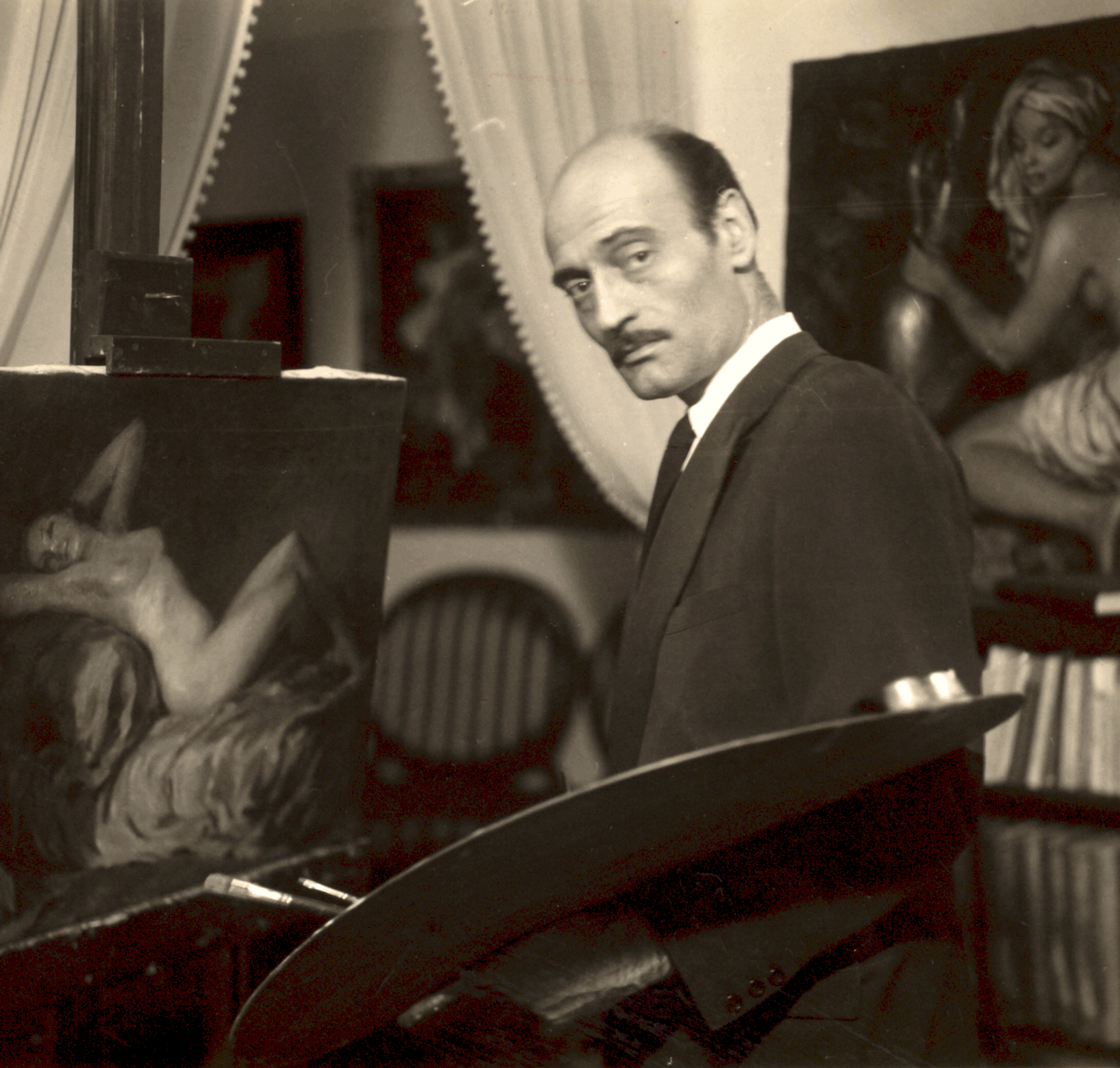
Self-portrait, c. 1940
Facts
- Birth
- 20 July 1912, Madrid
- Death
- 1 March 1996 (83)
- Nationality
- Spanish
- Occupation
- Painter, Teacher, Advertising Artist
- Training
- San Fernando School of Fine Arts (1927-1932)
- Mentor
- Manuel Benedito
Origins and Early Years
Enrique Gil Guerra (Madrid, 20 July 1912 - 1 March 1996) lived painting as a lineage: an Old World craft of patience, light, and character.
Son of Enrique Gil Perez, an engraver and goldsmith from a family in Almagro (Ciudad Real), and Leandra Guerra Galindo of Leonese roots (Villamartin de Don Sancho), he lost his father at the age of three. At eight he entered the Colegio de Huerfanos de San Ildefonso as a boarding student, where his artistic calling emerged and discipline took root. Drawings made when he was twelve and thirteen are still preserved.
Training at San Fernando
In the autumn of 1927, at just fifteen, he enrolled in Madrid's Escuela Superior de Pintura, Escultura y Grabado de San Fernando, graduating in 1932.
There he met Manuel Benedito, disciple of Joaquin Sorolla and a painter of the '27 generation, whose mentorship anchored Gil Guerra in a classical lineage of light and craftsmanship. Under Benedito's guidance he also took his first steps in teaching, his "other vocation" for the rest of his life.
He earned top marks (Merit and Honors) across many subjects, not only Drawing and Painting but also Modeling and Engraving. His outstanding record secured the summer scholarships: El Paular and Mallorca (1930), El Paular, Tossa de Mar and Betanzos (1931), and Granada (1933), residencies that let him paint across Spain's varied light. Works from the 1930 and 1931 scholarships were shown in exhibitions at the Museo de Arte Moderno, as reported by the press.
Early Recognitions
In 1930 he won the Open-Air Painting Prize of the School of San Fernando. In 1931 he received, unanimously from the faculty, a Gold Medal from the Circulo de Bellas Artes for the best work from the El Paular scholarship (12 November 1931).
The year he graduated coincided with the retirement of the celebrated colorist Cecilio Pla. Gil Guerra's presence in the group that bid him farewell was noted in the press, and over time Pla's influence became evident in the young artist's palette.
In the summer of 1933, during the Alhambra scholarship (today's Parador de San Francisco), he met the Granadan sculptor Pablo de Loyzaga and his daughter Maria Elvira de Loyzaga, also a sculptor, whom he married in 1942 after the Civil War.
Independent Artists and First Exhibitions
After graduating he took part, between 1932 and 1933, in exhibitions by the group known as "Independent Artists," several of them held in the salons of the newspaper El Heraldo de Madrid.
His works stood out decisively in a collective exhibition at the Ateneo de Madrid in May 1934, already noted for the combination of strong drawing and impressionist color in the backgrounds.
While doing military service he received a travel grant (Ministerial Order of 25 July 1934) to attend the National Exhibition of Fine Arts. He presented a work on Las jovenes y La Musica in 1935, and Torerillos in 1936.
Professor and Civil War
In July 1936, just before turning twenty-four, he passed the competitive exams for secondary-school chair in Drawing and Painting. He was summoned to collect the diploma on the morning of 19 July 1936 at the Ministry of Public Instruction and Fine Arts, but the events at the Cuartel de la Montana prevented it.
The Civil War (1936-1939) clearly altered his professional prospects.
Advertising and Teaching
In the postwar years he turned to advertising illustration, which offered more professional activity at the time. Under the pseudonym Nike, and sometimes his own surname, he worked for several firms, especially the Madrid company Valeriano Perez (later Hijos de Valeriano Perez), bringing the same draftsmanship to commercial commissions.
His advertising work received notable recognition: First Prize in the poster competition for the III Fiesta de la Vendimia and Feria de Jerez de la Frontera (1950 and 1951), Third Prize at the III National Advertising Exhibition of the newspaper Pueblo (1951), and the Medal of Honor at the 1st International Exhibition of Handicrafts (1953).
In teaching, he joined Madrid's School of Arts and Crafts (later Applied Arts and Artistic Trades) around 1942, teaching statue drawing, painting, and advertising drawing until his retirement in 1982.
Artistic Maturity
In late May 1962 he held a major solo exhibition at Madrid's Sala Alcon, presenting figurative works that drew press attention and specialist reviews. Critic Jose Prados Lopez, perpetual secretary of the National Association of Painters and Writers, wrote:
"Gil Guerra, with the highest prestige in so many endeavors of life, is an unadapted and unadaptable man to the confusing climate that surrounds us. In this exhibition there is a painter who masters the craft, who owns an experience, the teacher of creations."
In 1966 he exhibited again at Sala Alcon, this time devoted to nature and floral themes. Prados Lopez again praised the "elegant phrasing of his themes, directed toward higher achievements of grouping and color."
Style and Themes
His work sits within the realism of the early 20th century, steeped in the sunlit atmosphere of Spain, although during his studies at San Fernando he briefly absorbed the cubism of Vazquez Diaz, natural for a student who arrived one course after Salvador Dali.
After the Civil War he focused on his innate realism in portrait, landscape, and figure, cultivating Spanish costumbrist subjects that evoke Old Europe:
- Flamenco Art and Aguadoras: Typical figures from Andalusia
- Flamenco Dancers: Movement and passion in dance
- Landscapes: Urban and rural views of Spain
- Portraits: A genre in which he excelled
The last period of his artistic life (1970-1996) evolved toward impressionism, arriving at a balance between the realism that always defined him, the figure, and impressionist technique.
International Recognition
Between 1934 and 1992 he produced a large number of oil portraits and paintings acquired by galleries and private collectors in the United States, Canada, Colombia, Venezuela, Chile, Sweden, France, England, Belgium, Japan, and Spain, carrying his Old World sensibility across the Atlantic and beyond.
Several of his best-known works became widely popular through reproduction in calendars and posters, carrying a sense of Old Europe into everyday life.
Works in Collections
The well-known painting Espiga Rota, awarded in 1970 in a competition by Union de Explosivos Rio Tinto, is held in that collection alongside works by Romero de Torres and Francisco Ribera.
Other works such as Arlequin, Vendedor de gafas, and Bailaora belong to the extensive collection of Ulloa Optico.

Biography documented in the Biographical Dictionary of the Royal Academy of History • Source: Royal Academy of History, Spanish Biographical Dictionary